Airline Hub Guide: Which U.S. Cities Are Major Hubs and Why It Matters

The favored model of the American airline industry since its deregulation in 1978,
airport hubs have formed the backbone of the country’s present-day aviation network
and marketplace. Nowadays, these hub-and-spoke systems have become ubiquitous in the
U.S. travel sphere, replacing most previous point-to-point models offered by airlines.
By providing greater efficiency and profitability, the hub system is here to stay, so let's
look at how this transportation model can benefit both the airline and the passengers it
carries.
Why Hubs Matter for Passengers
In a perfect world, every flight would be nonstop, and you'd be jetting off to your
destination without any extended connection times or roundabout routings. But in
that perfect world, your airfare would likely cost triple.
So why do hubs matter for passengers? The almighty dollar. If airlines can reduce costs
by running an efficient hub-and-spoke system, they can, in theory, pass along the savings
to the customer. While airport connections aren’t always ideal, hubs allow carriers to
provide more extensive route networks, streamlined operations, and lower fares.
And those low fares come in several forms.
Some of the best-unadvertised savings in the entire aviation marketplace come in the form
of hub attacks by competing airlines. These fare wars are often instigated by rival carriers
trying to undercut prices on select routes from a competitor's hub airport, sometimes
to the tune of hundreds of dollars.
Delta might try to drum up sales in a market such as Houston (IAH) that is traditionally
dominated by United Airlines by listing fares to destinations in, say, Europe or Hawaii,
for half the going price. By instigating a fare war, Delta can cut into United’s hub profits
and sway customers who are generally handcuffed to United’s monopolized airfares to try
its product instead.
These so-called fare wars often escalate quickly, with multiple airlines getting in on
the action targeting rivals’ hometown hubs across the country. Knowing which hub is nearest
to you and which airlines tend to undercut prices during fare wars might be key to grabbing
a rock-bottom fare during one of these short-lived, unadvertised sales and saving big.
Why Hubs Matter for Airlines
Consolidated route networks significantly contribute to how airlines can reduce
overhead on their overall operational costs. Hubs allow airlines to funnel feeder
flights with lower passenger volumes through strategically placed airports without
having to allot larger aircraft on less popular city-to-city pairings. Thus,
adjusting for the total number of travelers on routes and reducing empty seats – the
bane of every carrier’s bottom line.
For example, instead of offering a nonstop point-to-point option between two smaller cities
like Des Moines (DSM) and Dayton (DAY) that would more than likely fly half empty, these
two markets connect through a midway hub like Detroit (DTW) or Chicago (ORD). This allows
the airline to better utilize its aircraft and corral passengers between the two points
at a profitable schedule while reducing its risk of low passenger loads.
Hubs also provide airlines with a centralized work base for employees, allow for more
timely mechanical fixes, and provide additional options for aircraft swaps or adjustments,
all of which significantly reduce operating costs compared to a point-to-point system.
A List of Airport Hubs Across America
The following is a list of major U.S.-based carriers and the location of their airport hubs and cities.
(Red dots indicate hubs – Yellow for focus cities)Alaska Airlines
Focused on West Coast markets, Alaska Airlines operates six hubs, with its primary hub and headquarters located at Seattle–Tacoma International Airport (SEA). In recent years, Alaska has elevated San Diego (SAN) from a focus city to full hub status, now offering more nonstop destinations from SAN than any other airline. Focus cities of Boise (BOI) and San Jose (SJC) round out the carrier’s prodigious Pacific Coast presence.
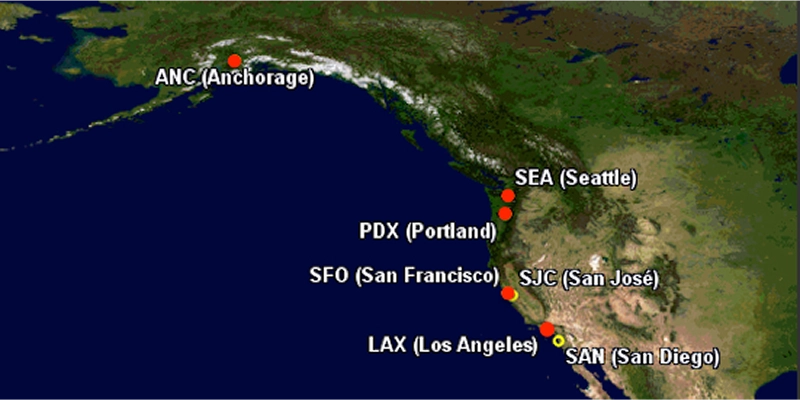 Hubs
Hubs - Seattle/Tacoma (SEA) – Primary Hub
- Anchorage (ANC)
- Los Angeles (LAX)
- Portland (PDX)
- San Diego (SAN)
- San Francisco (SFO)
- Boise (BOI)
- San Jose (SJC)
American Airlines
As the world's largest airline, American carries over 200,000,000 passengers annually through its ten major U.S. hubs. While unofficial, Dallas/Fort Worth (DFW) is considered the airline’s primary hub and home to the company’s global headquarters. American briefly designated Austin (AUS) as a focus city in 2021, adding multiple point-to-point routes, but ended the experiment in 2024 and returned to serving AUS only from its main hubs.
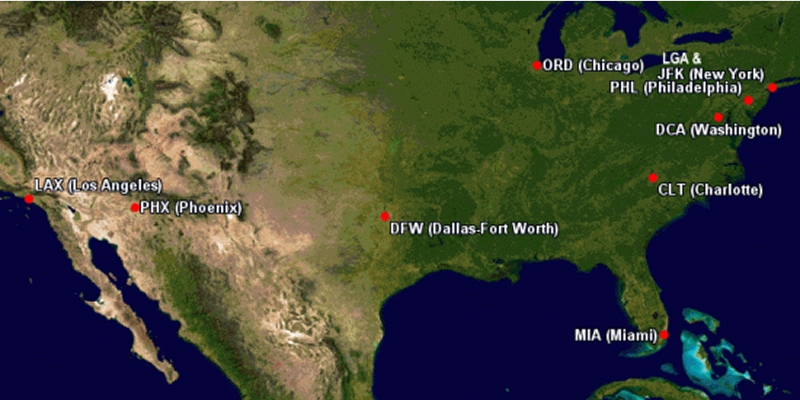 Hubs
Hubs - Dallas/Fort Worth (DFW) – Primary Hub
- Charlotte (CLT)
- Chicago–O’Hare (ORD)
- Los Angeles (LAX)
- Miami (MIA)
- New York–Kennedy (JFK)
- New York–LaGuardia (LGA)
- Philadelphia (PHL)
- Phoenix (PHX)
- Washington DC–National (DCA)
Delta Airlines
Considered to be the first mega-hub in America, Atlanta’s Hartsfield–Jackson International Airport (ATL) is also the world’s busiest and the primary hub for hometown Delta Air Lines. In 2024, ATL handled 108.1 million passengers, retaining its spot as the busiest airport globally. After finalizing its merger with Northwest Airlines in 2010, Delta inherited hubs at Minneapolis (MSP) and Detroit (DTW) and upgraded its presence in Boston (SEA) in 2019, bringing its total hub count to nine. In 2023–2024, Delta significantly expanded its Austin (AUS) focus city, making it the airline’s number two Texas market after Atlanta. In 2024, Delta also began testing a new focus-city model in Orlando (MCO) with added leisure routes.
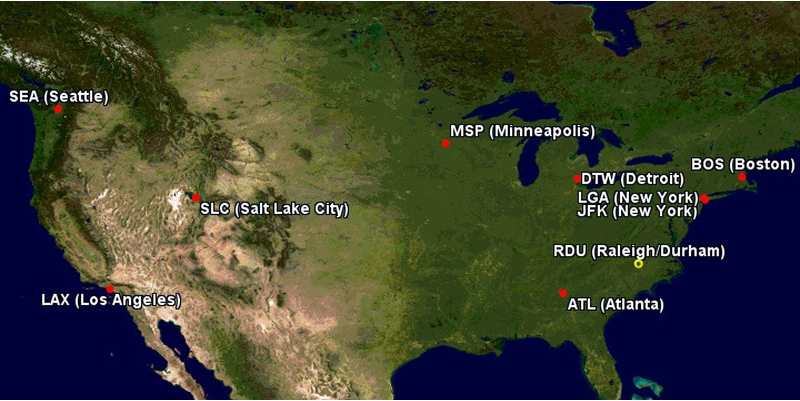 Hubs
Hubs - Atlanta (ATL) - Primary Hub
- Boston (BOS)
- Detroit (DTW)
- Los Angeles (LAX)
- Minneapolis/Saint Paul (MSP)
- New York–Kennedy (JFK)
- New York–LaGuardia (LGA)
- Salt Lake City (SLC)
- Seattle/Tacoma (SEA)
- Raleigh/Durham (RDU)
- Austin (AUS)
- Orlando (MCO)
United Airlines
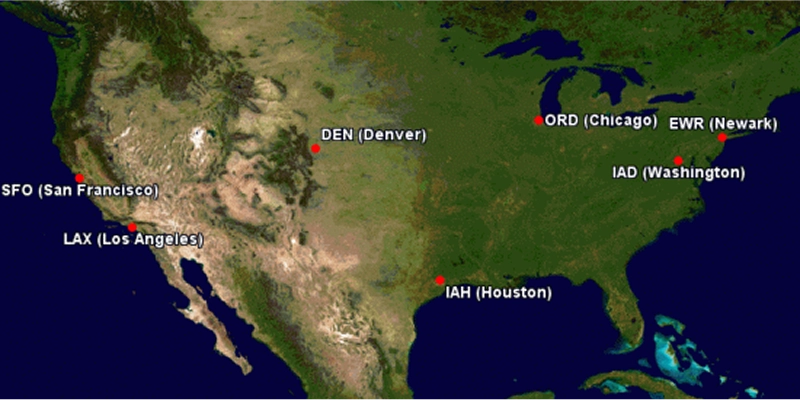
Chicago-based United Airlines operates a total of seven hubs in the United States, including its prime base at hometown O'Hare (ORD) airport. Its merger with Continental Airlines in 2010 has resulted in the addition of Newark (EWR) and Houston-Intercontinental (IAH) to its roster of hub airports. Cleveland Hopkins International (CLE), a former Continental hub, has been disbanded by United in favor of increased service at other regional airports. Recently, United has significantly expanded existing ones, particularly Denver (DEN), where it added new gates and more daily departures, making DEN its fastest-growing hub.
 Hubs
Hubs - Chicago–O’Hare (ORD) - Primary Hub
- Denver (DEN)
- Houston–Intercontinental (IAH)
- Los Angeles (LAX)
- Newark (EWR)
- San Francisco (SFO)
- Washington DC–Dulles (IAD)
Hawaiian Airlines
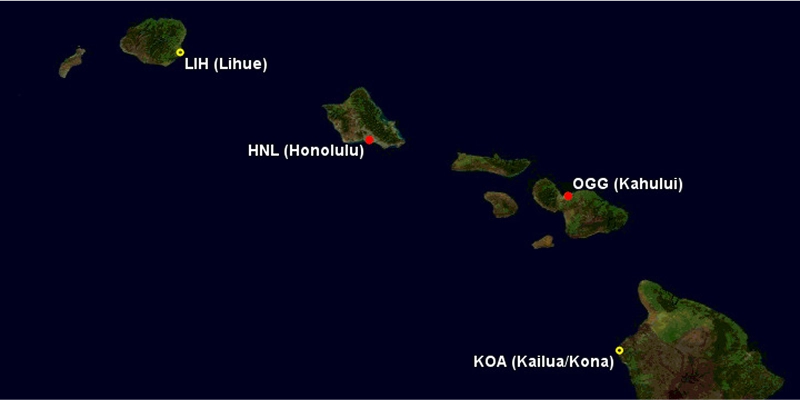
Honolulu-based Hawaiian Airlines operates two hubs in the 50th state–its headquarters at Daniel K. Inouye/Honolulu International Airport (HNL) and its secondary outpost on the island of Maui at Kahului Airport (OGG). Kona International Airport (KOA) and Lihue Airport (LIH) serve as focus cities for the airline.
 Hubs
Hubs - Honolulu–Oahu (HNL) - Primary Hub
- Kahului–Maui (OGG)
- Kona–Big Island (KOA)
- Lihue–Kauai (LIH)
Frontier
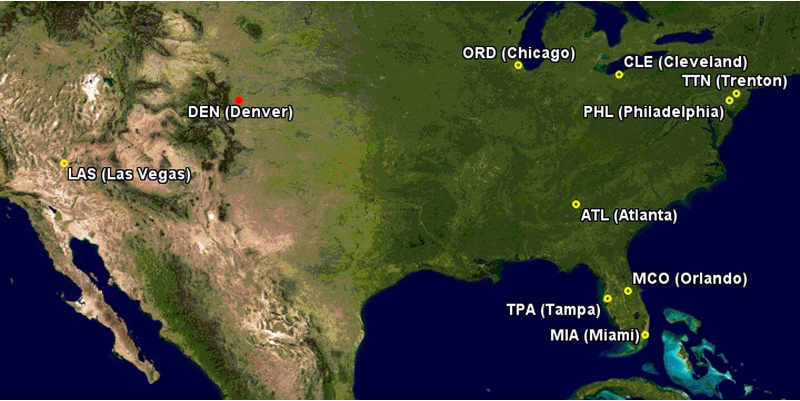
Frontier Airlines forgoes maintaining multiple hubs across its network and relies on a patchwork of focus cities to connect its low-cost customers to their destinations. The budget carrier supports a solitary hub at Denver International Airport (DEN) through which most of its West Coast connections route. On East Coast operations, Frontier tends to lean toward a point-to-point model but often routes passengers through one of its nine focus airports.
 Hubs
Hubs - Denver (DEN) – Operating Base
- Atlanta (ATL)
- Chicago–O’Hare (ORD)
- Cleveland (CLE)
- Las Vegas (LAS)
- Miami (MIA)
- Orlando (MCO)
- Tampa (TPA)
- Philadelphia (PHL)
- Trenton (TTN)
Sun Country Airlines
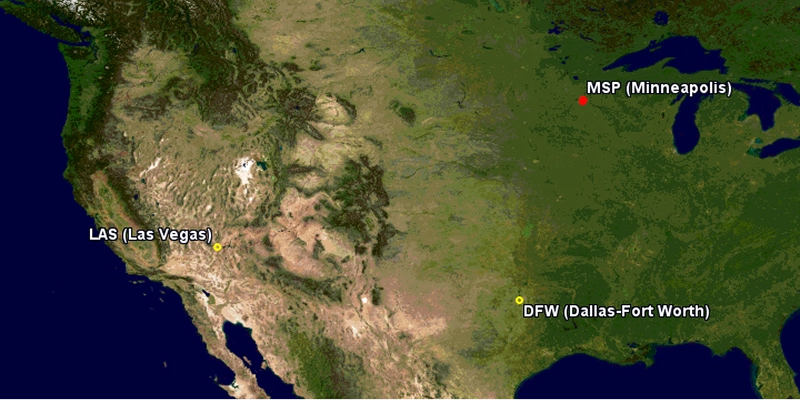
Ultra low-cost carrier Sun Country’s route network is primarily connected through its sole hub at Minneapolis-Saint Paul International Airport (MSP). Over the last several years, the airline has rapidly expanded its route network outside the confines of its Minnesota hub by adding focus airports at Dallas-Fort Worth (DFW) and Las Vegas (LAS).
 Hubs
Hubs - Minneapolis/Saint Paul (MSP) – Primary Hub
- Dallas/Fort Worth (DFW)
- Las Vegas (LAS)
Airlines With Operating Bases and Focus Cities Instead of Hubs
Not all airlines rely on the hub-and-spoke system; many provide point-to-point networks to route passengers on strategically chosen flight paths to compete with legacy carriers.
JetBlue
New York-based JetBlue prefers to maintain a single operating base at New York's John F. Kennedy Airport (JFK) instead of proclaiming a primary hub. The airline's low-cost model is heavily reliant on nonstop point-to-point offerings rather than funneling its passengers through the more common hub system. With focus airports in five other cities like Boston (BOS), Orlando (MCO), Ft. Lauderdale (FLL), Long Beach (LGB), and San Juan (SJU), JetBlue’s network leans heavily on East Coast air traffic.
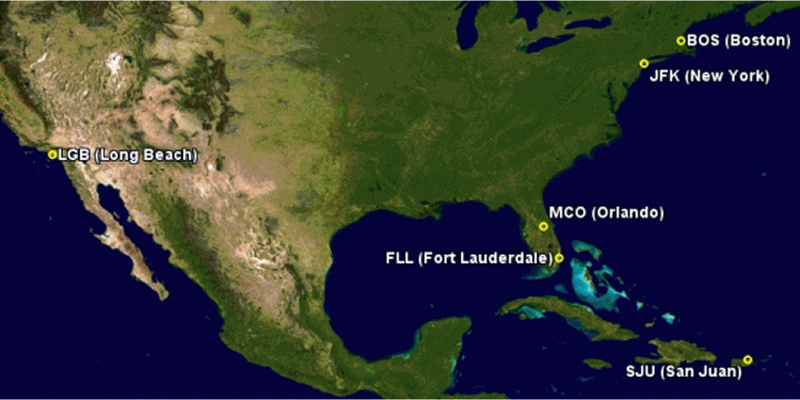
- New York-Kennedy (JFK) – Operating Base
- Boston (BOS)
- Fort Lauderdale (FLL)
- Long Beach (LGB)
- Orlando (MCO)
- San Juan (SJU)
Southwest Airlines
The anti-establishment answer to the hub-and-spoke system, Southwest has made its mark as the top airline to favor a point-to-point delivery for its passengers. As the largest domestic carrier in the United States, Southwest prefers to assign its important airports as operating bases. The airline currently lists 11 airports as operating bases. Southwest's recent expansion to Hawaii has given the carrier a strong presence at Honolulu International Airport (HNL), but the airline has yet to designate it a focus city or operating base. In 2024, Southwest added Nashville (BNA) as its newest crew base and expanded Denver (DEN) to become its largest operation, with 40 gates and over 170 daily departures.
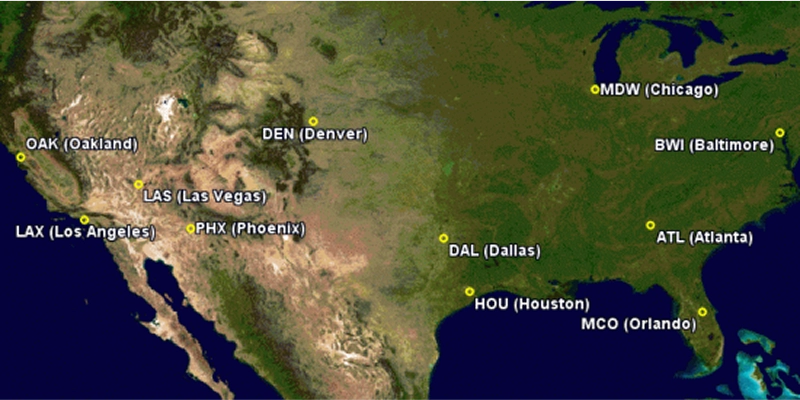 (Only airports designated as operating base shown)
 - Atlanta (ATL)
- Baltimore (BWI)
- Chicago–Midway (MDW)
- Dallas–Love Field (DAL)
- Denver (DEN)
- Houston–Hobby (HOU)
- Las Vegas (LAS)
- Los Angles (LAX)
- Nashville (BNA)
- Oakland (OAK)
- Orlando (MCO)
- Phoenix (PHX)
Featured image by Nazarkru / Shutterstock.com
By AirfareWatchdog
By Megan Johnson
By Peter Thornton
By David Landsel
By Carol McPherson
By Ricky Radka
By AirfareWatchdog
By Megan Johnson
By Peter Thornton
By David Landsel
By Carol McPherson
By Ricky Radka